

RCF Annual
Regional Conference
From Skills Shortage to Talent Pipeline: Strengthening VET–Business Partnerships in the Western Balkans


17 November 2026
About the conference
The conference “From Skills Shortage to Talent Pipeline: Strengthening VET–Business Partnerships in the Western Balkans” will bring together enterprises, VET providers, chambers of commerce, policymakers, donors, social partners and regional experts to explore how stronger business-supported cooperation between vocational education and training and the private sector can help address skills shortages, build sustainable talent pipelines and support companies in the WB6 in becoming more competitive and ready for deeper integration into EU value chains.
With a clear focus on practical cooperation, dual education and work-based learning, the conference will highlight how partnerships supported by the Regional Challenge Fund contribute to improving the relevance, quality and responsiveness of VET, while helping businesses strengthen technical, digital, green, quality and compliance-related skills.
Participants will explore practical models for company–VET cooperation, ideas for engaging HR professionals and company mentors, lessons learned from the WB6 region, practical examples of VET support for company competitiveness, and recommendations for making work-based learning more attractive to enterprises and better aligned with business growth and EU market requirements.
Programme themes
From Skills Shortage to Talent Pipeline
Business leaders open the day with a strategic question: how can companies move from ad hoc recruitment to structured talent pipelines built together with VET providers? The dialogue looks at workforce planning, productivity and readiness for EU value chains, and at what companies need from VET partners beyond student placements.
Business–Education Cooperation that Closes Skills Gaps
Three RCF-supported consortia present concrete examples of cooperation between companies and education providers. They show which business or training problem the partnership addressed, what changed for companies, teachers, mentors and learners, and which practices other companies and VET providers in the region could adapt.
Skills Companies Will Need Next
A forward-looking conversation on how digitalisation, the green transition, AI and business resilience are changing the skills companies will need over the next three to five years. The focus is on what companies and VET providers should start preparing now, so that their cooperation becomes more flexible and responsive to emerging needs.
Lab Reporting and Prioritisation
From 14:00 to 15:40, participants work in two parallel solution labs, each built around one practical question. At 16:00 the labs report back in a short, interactive plenary. Everyone in the room helps decide which actions matter most.
Skills for EU value chains
What do companies need to meet EU value-chain requirements? The lab looks at how skills gaps affect growth, export readiness and work with EU partners, and which of them VET, dual education and work-based learning can close.
Making work-based learning work
What makes work-based learning worth it for both sides? The lab looks at the practical conditions that make it manageable for VET providers and companies, what support mentors need to run it well, and where the main gaps are.
Agenda
Tuesday, 17 November 2026 · Central European Time
Registration and Networking
Skills for Business, Skills for Europe
- Adnan Husic, Assistant Minister in the Education Sector, Ministry of Civil Affairs of Bosnia and Herzegovina, TBC.
- Representative, German Federal Ministry of Economic Cooperation and Development (BMZ)
- H.E. Alfred Grannas, Ambassador of the Federal Republic of Germany to Bosnia and Herzegovina, TBC.
- H.E. Gabriele Derighetti, Ambassador of Switzerland to Bosnia and Herzegovina, TBC.
- David Piegazki, Secretary General, Western Balkans 6 Chamber Investment Forum
From Skills Shortage to Talent Pipeline
- ModeratorJelena Manic Radoicic, RCF Deputy Team Lead and Regional Coordinator for Serbia
- Borka Mrsic, Human Resources Manager, Bosch Serbia, Belgrade, TBC.
- Arben Shkodra, Secretary General, Albanian Manufacturers Union and Albanian Economic Council, Tirana, TBC.
- Snježana Köpruner, CEO and Co-Owner, GS TMT, Travnik, TBC.
Coffee Break
Business–Education Cooperation that Closes Skills Gaps
- ModeratorDr Antonie Onosimoski, VET Expert and Author, Skopje
- Three RCF-supported consortia presenting examples of successful business–education cooperation: company mentors, teachers, apprentice or graduate voices
Skills Companies Will Need Next
- ModeratorsJulian Demeti, Albania Business Partners, and Renato Vasili, RCF Regional Coordinator for Albania
- Dr Hannes Tegelbeckers, Research Associate, University Magdeburg
- Kurt Wüthrich, Senior VET Expert, Helvetas, Skopje
- Admira Uzunic, Director, Electrical Engineering Secondary School, Tuzla
- Marina Braletic, Five Grupa, Podgorica
Lunch Break
Skills for EU Value Chains – Standards, Gaps and VET Responses
Exchange workshop on the practical skills and training gaps companies face when trying to meet EU value-chain requirements. How do these skills gaps affect company growth, export readiness, and ability to work with EU partners? Which of these gaps can be addressed through VET, dual education and work-based learning?
Making Work-Based Learning Work Better for VET Providers and Companies
- ModeratorJohann Schustereder, International VET Expert, Austria
Exchange workshop on the practical conditions that make work-based learning attractive and manageable for both VET providers and enterprises. What support do companies and mentors need to deliver effective work-based learning? Where are the main gaps, and how can they be addressed?
Coffee Break
From Discussion to Action: Lab Reporting and Prioritisation
Interactive plenary with brief solution lab reporting and action prioritisation.
Conference Conclusions and Closing
- Frieder Woehrmann, RCF Fund Management Unit Team Leader
- Representative, KfW
- Balsa Culafic, RCF Project Coordinator, Western Balkans 6 Chamber Investment Forum and Chamber of Commerce of Montenegro
Conference Dinner
Venue to be announced
Speakers
Opening Session: Skills for Business, Skills for Europe

Una Bejtovic is an award-winning communication expert, international public presentation skills trainer, and master of ceremonies with over 30 years of experience in public relations, media, and strategic communication. Since 2014, she has led her full-service agency, Bejtovic Communications, delivering hundreds of complex projects for corporate, government, NGO, and international clients. Recognized for her industry contributions, she received the 2023 Woman.Comm of the Year – Special Star Award. Her career milestones include working on a breaking news story at CNN International Desk in Atlanta, alongside global engagements as an MC and trainer in Annapolis, Abu Dhabi, Dubai, Vienna, and Munich. A guest lecturer bridging academic insight with practice, Una actively advocates for women's advancement, human rights, and civil courage. She is a PhD candidate in Global Studies at the University of Sarajevo, where she previously earned her Master’s in Democracy and Human Rights and Bachelor’s in Bosnian Literature and Language.
Business Dialogue: From Skills Shortage to Talent Pipeline

Jelena Manic Radoicic is a Senior Employability and Human Resources Expert with more than 20 years of experience in project management, workforce development and training. As Regional Coordinator and Deputy Team Leader of the Regional Challenge Fund, she supports partnerships between vocational education and training providers and enterprises across the Western Balkans, helping strengthen work-based learning and skills development.
Her expertise spans youth employment, career guidance and counseling, vocational education policy, and the green transition. She has advised and delivered training to businesses across sectors, working directly with managers on leadership, talent development, and career growth. With a combination of HR consulting and regional workforce expertise, she will moderate a dialogue with business representatives on addressing skills shortages.
RCF Partnerships Spotlight: Business–Education Cooperation that Closes Skills Gaps

Antonie Onosimoski is a senior VET, skills development and labour market specialist with 28+ years of experience in national and international development projects, primarily in North Macedonia and the wider Balkan region. At the beginning of his career, he worked for six years as a VET teacher, gaining first-hand experience in vocational teaching, practical skills development and cooperation with employers. He holds a PhD in Management – Competences of Teachers, a Master’s Degree in HR Management and a degree in Electrical Engineering.
His professional experience combines VET policy, skills development, employment and institutional reform with extensive cooperation between VET providers, employers, industry and public institutions. He has supported employer-responsive curricula and training, work-based learning, dual VET, company-specific skills programmes, partnerships with businesses, and stronger social dialogue and private-sector engagement.
For nearly three decades, he has contributed to development projects supported by the EU, World Bank, ETF, OECD, SDC, USAID and other international organizations, working with ministries, VET institutions, employment services, employers and social partners. His recent work focuses on work-based learning, VET excellence, innovation, lifelong learning, partnerships and the development of Centres of Vocational Excellence.
Future-Ready Talent Pipelines: Skills Companies Will Need Next

Dr. Hannes Tegelbeckers is a research associate at the Chair of Vocational and Business Education at Otto-von-Guericke-Universität Magdeburg, headed by Prof. Dr. Frank Bünning. His work focuses on technical and vocational education and training (TVET), teacher education, AI literacy, international cooperation, and open educational resources (OER). He is also affiliated with the UNESCO-UNEVOC Centre Magdeburg and serves as a UNESCO-UNEVOC AI Expert. He co-authored the UNESCO practical guide "Integrating AI in TVET". At OVGU, he is the speaker of the working group Digitalisation in Teacher Education (AK Digitalisierung im Lehramt) and a member of the Focus Group AI (Fokusgruppe KI).
Solution Lab B: Making Work-Based Learning Work Better for VET Providers and Companies

Johann Schustereder, a citizen of Austria, is a freelance education consultant and COE of NOVUM CONSULTING Education & Competency Development. After a career in teaching in Austria, Mr. Schustereder served as representative in educational cooperation between Austria, Russia and Ukraine. Following assignments in international organizations, including the OSCE in Macedonia, he has worked as fulltime education consultant since 2013. Mr. Schustereder has implemented several large projects for the European Commission, the Asian Development Bank, the World Bank Group, the GIZ and the KfW. His fields of expertise include vocational education and training, adult education, lifelong learning, project preparation and implementation, analysis of education systems, feasibility studies, and curricula development. His current assignments include a KfW-financed project in Ukraine with focus on infrastructure rehabilitation, the establishment of centres of excellence and the promotion of adult education. Mr. Schustereder is fluent in German, Russian, English and French.
Conference Conclusions and Closing
Relive the 2025 conference
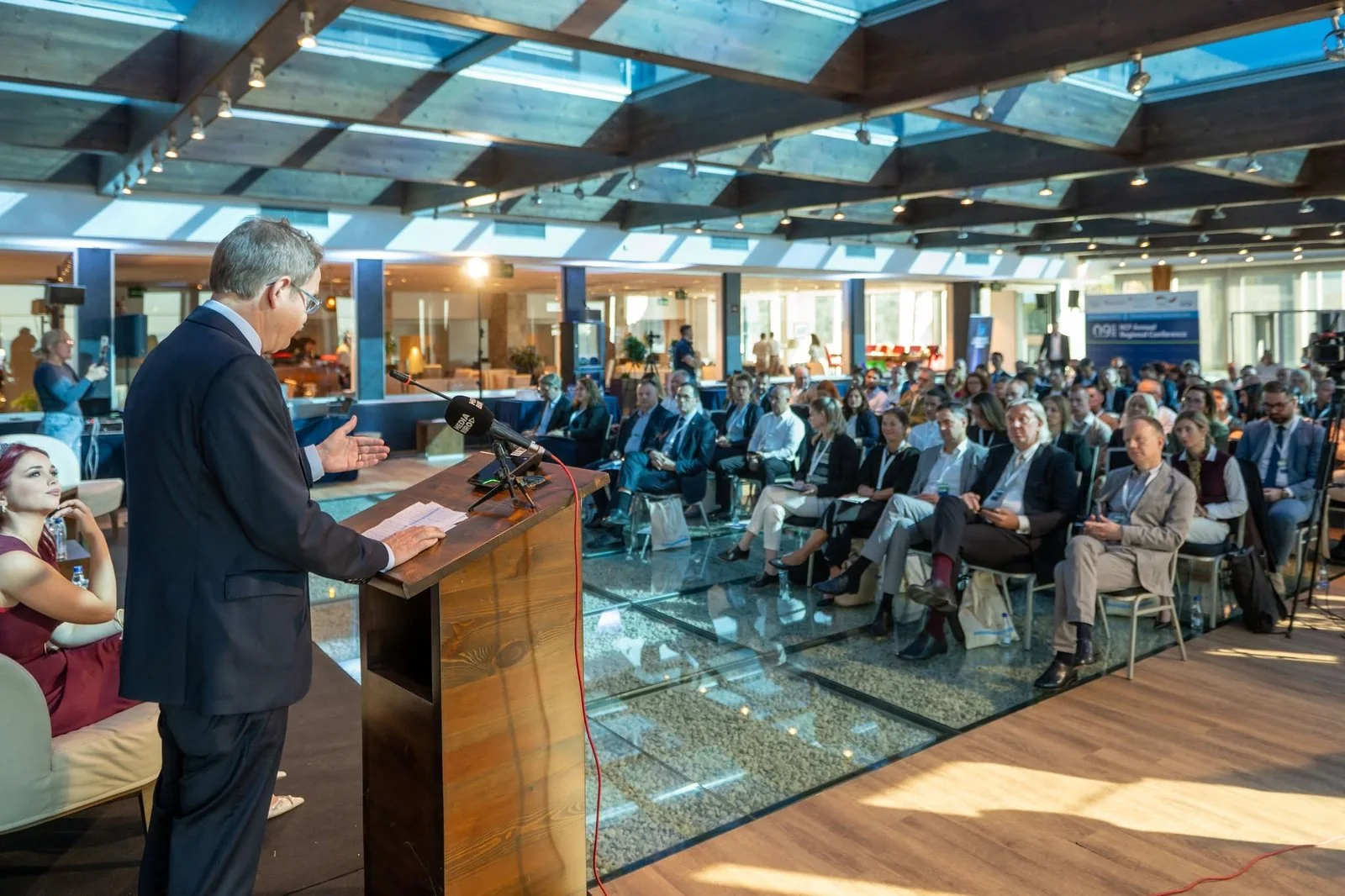
The RCF Annual Regional Conference 2025 took place on 9 October in Budva, Montenegro.
Watch the highlights of last year’s conference, held under the theme “Smart Balkans: Shaping Skills for a Sustainable, Competitive Future – Navigating VET in a Digital and AI World”.
Partners in skills: the Net4VET Challenge
The Net4VET Challenge is an annual initiative of the Regional Challenge Fund. It invites RCF-awarded consortia to show on the Net4VET platform what their VET–business partnership has achieved.
In 2026 the spotlight is on the partnership itself. Skills are built jointly by VET institutions and enterprises, working side by side, and the strongest examples from across the Western Balkans earn a place on the conference stage. Six to twelve consortia will be selected, depending on the quality of applications. In 2025, twelve consortia were awarded.
Follow the conference online
Join the conversation online, wherever you are.

Hotel Hills, Sarajevo
Hotel Hills Sarajevo Congress & Thermal Spa Resort, Bosnia and Herzegovina
- Address
- Butmirska cesta 18, Ilidža, 71000 Sarajevo
- Hotel contact
- +387 33 947 947
info@hotelhills.ba
hotelhills.ba


Frequently asked questions
Can I follow the conference online?
Yes. The conference is hybrid, on site in Sarajevo and online. The programme until 13:00 CET can be followed online.
Who is the conference for?
Businesses, VET providers, chambers of commerce, policymakers, donors and regional experts from across the Western Balkans.
Which language will the conference be held in?
The conference is held in English, with interpretation into Albanian, Macedonian and Bosnian, Serbian and Montenegrin.
Is there a participation fee?
No. Online attendance is free of charge.
Follow the conversation
#RegionalChallengeFund #RCF #WesternBalkans
Questions? info@rcf-wb6.org